
Find your fit
Who it is for
Trade businesses with repeatable pricing. The strongest starting point is a service whose usual prices, quantities, options and exceptions can be described clearly: for example furnace replacement, roofing, fencing or painting. Templates cover 17 trades, but the business supplies and checks its own prices. A template’s sample amount is not a local market recommendation.
Owners who want useful inquiries from their website. The customer can explore the work and its preliminary price before speaking with the team. Businesses choose whether contact details are requested, and the resulting inquiry keeps the job answers and the estimate together. The workflow can support a sales conversation without promising that every visitor will become a customer.
Teams managing several services. A business can keep separate estimators for different offerings, reuse rates in a price library, and invite editors or lead handlers. The owner can choose whether editors may publish. Compare the one-live-estimator free allowance with the unlimited plan when deciding how many services to expose.
Work that still needs a visit. Unknown answers can produce a range, a stated assumption or an assessment request. The furnace template explicitly does not size equipment or replace a load calculation. For complex or site-dependent work, use the estimator to establish context rather than make an unsupported final commitment.
The work it supports
Core capabilities
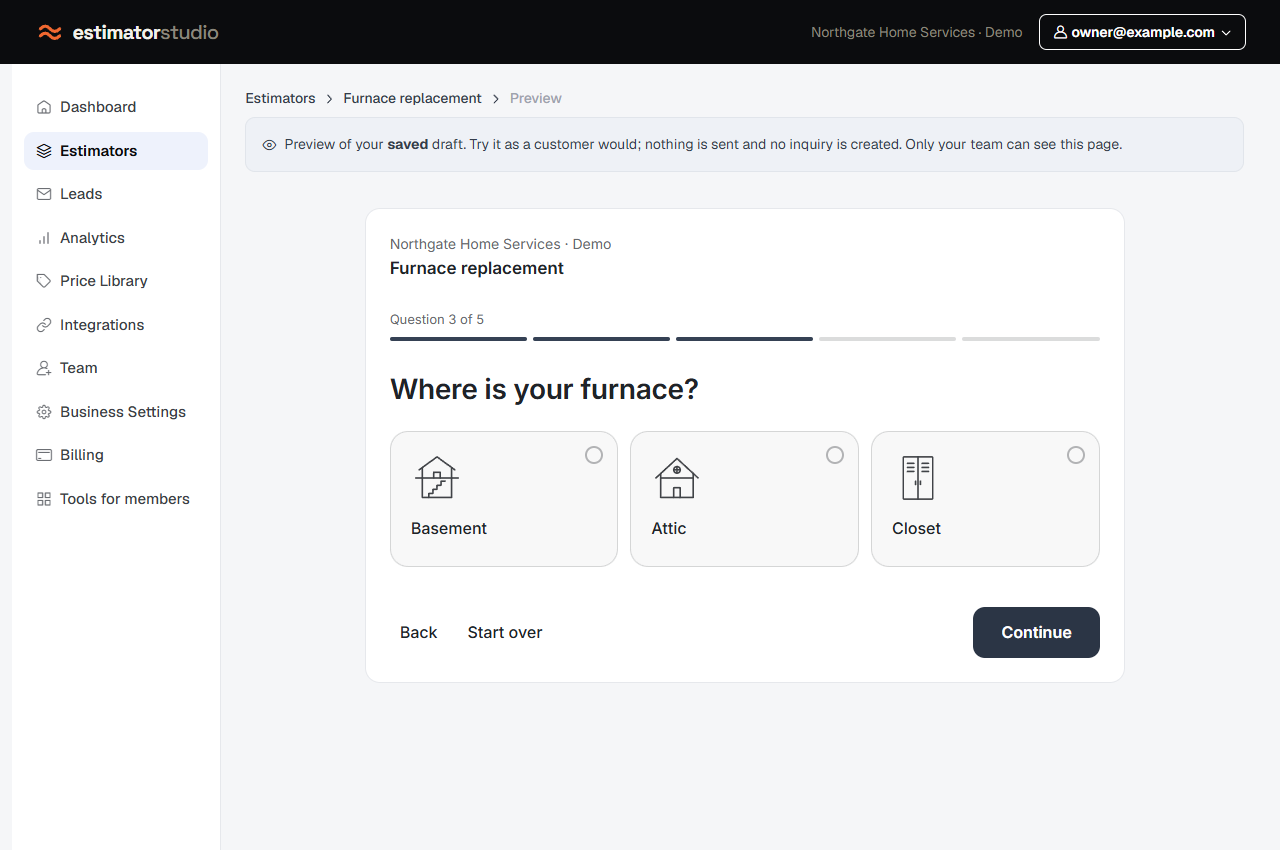
Questions that follow the job. Build choice, yes/no, numeric and measurement questions, including quantities such as length, area and length × width. Conditional visibility can show a follow-up only when an earlier answer calls for it. Set how uncertain answers should behave instead of silently treating missing information as a firm answer.
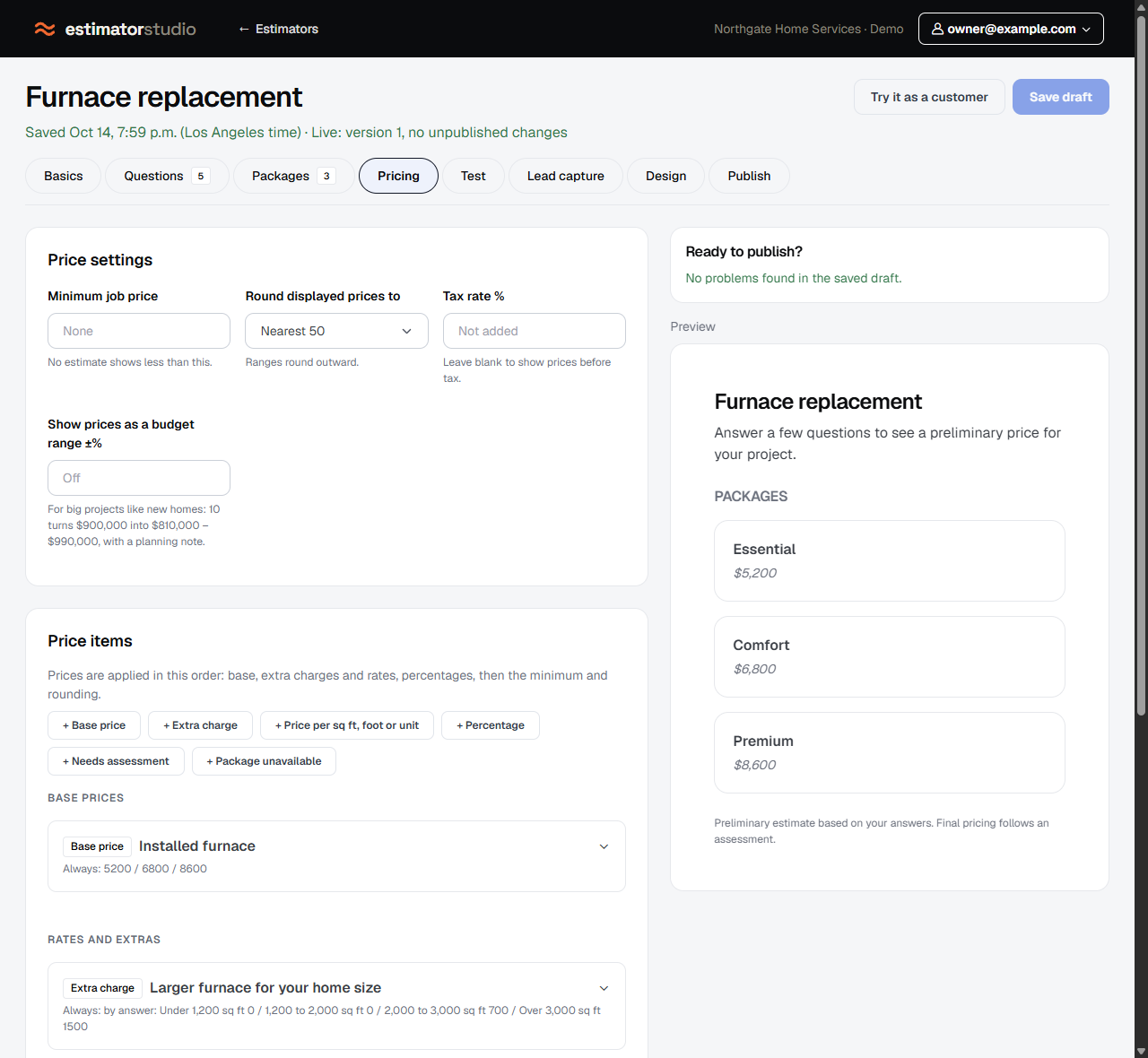
Your own pricing rules. Enter base prices, fixed extras, per-unit rates, percentages of named items and a minimum job price. Package inclusions can identify an item as already included. The point is to model the business’s pricing logic; it does not import an authoritative industry price list or determine what a contractor ought to charge.
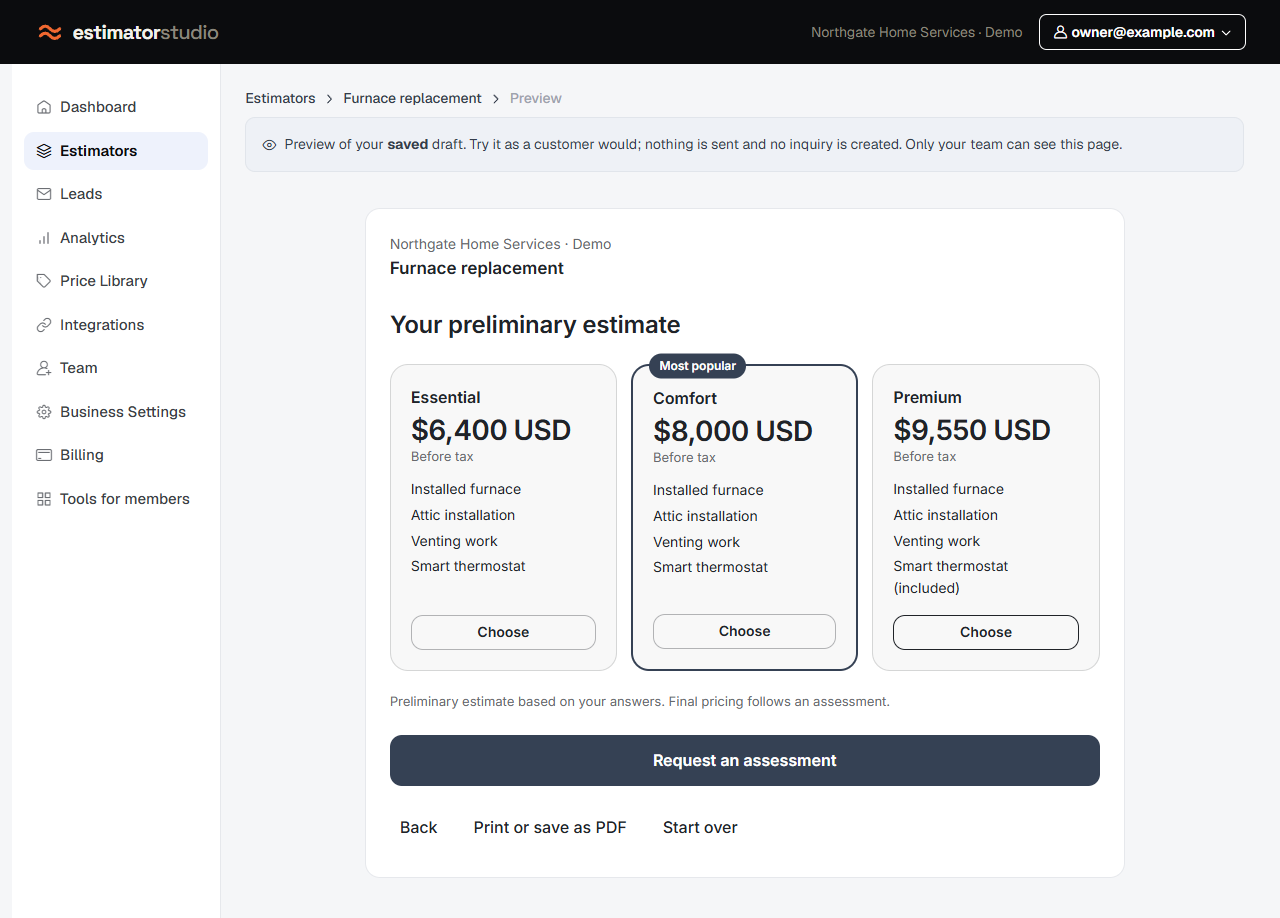
Packages and price ranges. Offer one price or up to six packages side by side, with distinct names, descriptions and included items. Unknowns can widen a result to a range or route the work to assessment. The resulting figure remains preliminary and subject to the business’s stated assumptions and normal assessment.
A reusable price library. Keep rates in a shared library and see where they are used across estimators. This can reduce repeated editing when several services use the same item. Treat a changed price, a saved draft and a republished customer version as separate steps; review affected estimators before changing the offer customers see.
Website installation and design. Configure fonts, colors, corners, answer presentation, layout, text size and a logo. Publish through a short embed snippet on a site that accepts HTML, or use the estimator’s hosted link. The hosted route is useful when a website plan restricts scripts; it is not a promise of tested compatibility with every builder and subscription tier.
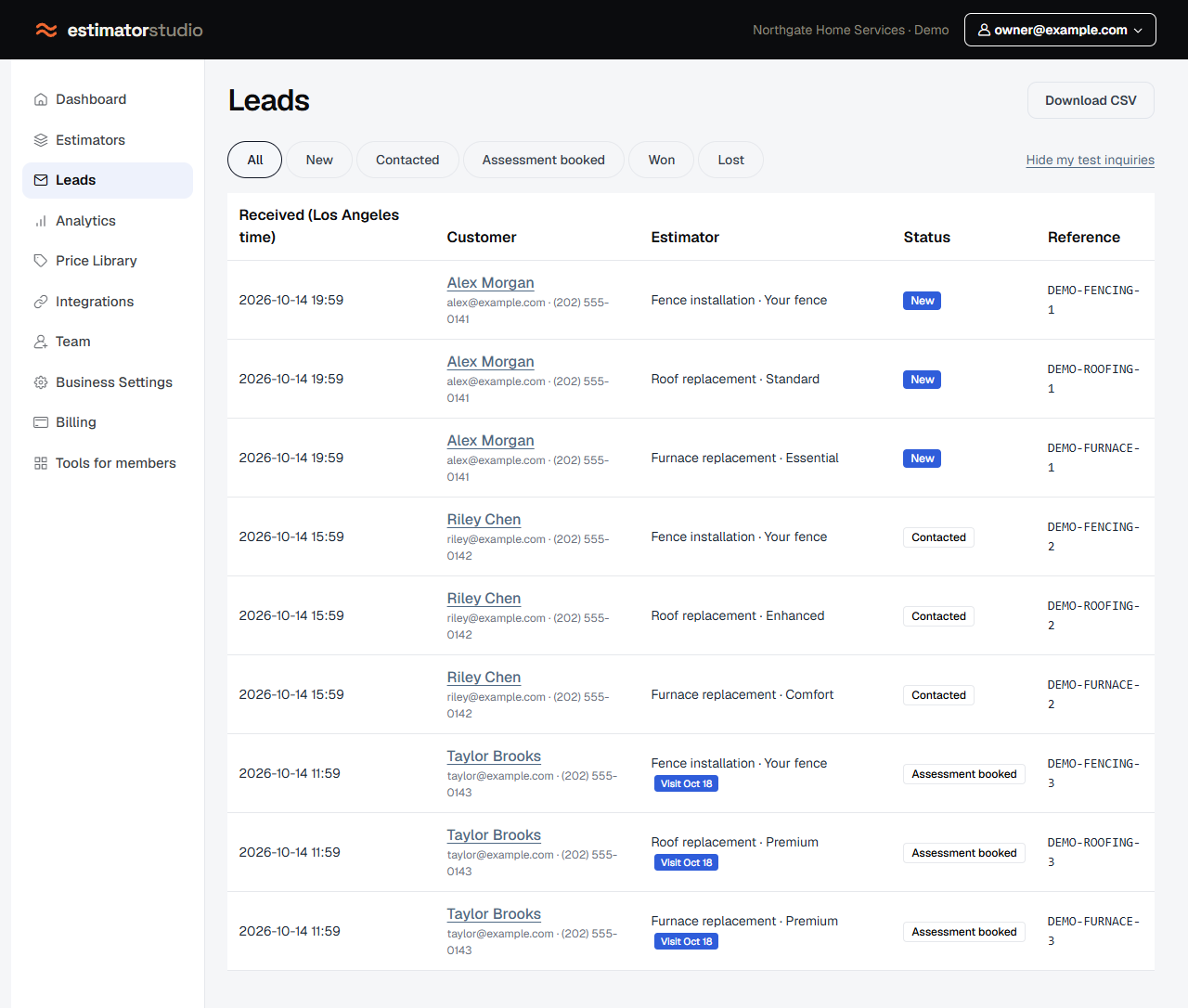
Inquiry handling and follow-up. The inbox retains customer answers and the exact estimate shown, along with status and team notes, and supports spreadsheet export. Optional visit booking asks for an available day; a person confirms the time. Owner alerts, requested customer copies and print/PDF options support the handoff without making the estimate a booked job or binding quote.
Testing, versions and connected work. Privately try known jobs before publishing a version, then switch back if needed. Reporting covers visits, starts, completions, prices shown, inquiries and package interest. Signed inquiry webhooks support Zapier or a suitable receiving system, with retries and delivery history; confirm the receiver and field mapping rather than assume a ready-made native integration with every CRM.
Understand the offer
Pricing and getting started
Free is a live allowance, not just a trial. The current pricing page offers one estimator live on a website or hosted link indefinitely, with no card required. It includes inquiries, alerts, reporting, booking and connected workflows. A linked Powered by Estimator Studio badge identifies the free installation. Sample prices still need review before a business publishes its own estimator.
Unlimited pricing. The published monthly price is US$35 for a business in the United States or CA$45 in Canada. It adds unlimited live estimators while keeping the same feature set. Billing is monthly through Stripe; check the current checkout and any connected provider’s separate charges rather than treating a displayed estimate currency as the subscription currency.
CloudLine member pricing. Businesses already paying for an eligible ProsGrade or ReviewTec subscription may qualify for unlimited estimators at US$10 or CA$13 per month with a member code. Each tool keeps its own account and bill. If the qualifying subscription ends, the published policy returns the price to the regular amount from the next renewal with an advance email.
Cancellation and retained work. Cancel from Billing at any time. Paid access continues to the end of the paid period; after that the first estimator stays on the free plan and additional live estimators pause. Drafts and inquiries are retained. The published refund policy does not offer part-month or unused-time credits; check the policy before starting a subscription.
Prepare the business before going live. Begin with installed prices or rates, the services and options actually offered, and access to edit the website or someone who can add the snippet. Compare private test results with familiar past jobs. Buying a plan does not itself publish an estimator: publish the version deliberately after reviewing its prices and assumptions.
Look a little closer
Before you choose
A preliminary estimate is not an accepted quote. Customers see prices or ranges based on their answers and the business’s numbers. Final scope and pricing follow the normal assessment. This listing does not imply built-in equipment sizing, engineering calculations, job dispatch, invoicing or taking customer payments. Confirm any additional workflow separately.
Check the exception paths. Try uncertain measurements, missing information and jobs the business cannot price online. The tool can use ranges, assumptions or assessment requests, but the owner must decide which response is appropriate. A polished form should not hide a pricing rule that gives the wrong result for an unusual job.
Plan the customer-data handoff. Inquiries can contain contact details, job answers and estimate information. Decide who can see them, which fields are needed, where exports go and whether an external webhook receiver should receive that data. A named Zapier path does not remove the need to configure and check the destination.
Install and publish deliberately. The vendor has not tested every website builder or plan. Keep the hosted-link fallback available when embed code is restricted. Saving a changed draft and publishing a customer-visible version are separate, and existing sessions may retain the version they started with. Recheck the customer journey after a price or design change.
Shared ownership disclosure. Estimator Studio and SoftwareExplained are part of the same software group. This profile uses the retained official material and an inspection of the current project. Gallery screens use fictional sample businesses and prices; they are interface demonstrations, not real inquiries, measured conversion results or an independent customer endorsement.
8 distinct sources behind this profile. Research observed Oct 15, 2026. Features and offers can change.
View sources and research →