Find your fit
Who it is for
A household or small team with receipts, correspondence and other documents can use Docspell without deciding a folder for every upload. Items can have tags, correspondents, dates and custom fields; a shared collective lets several users work in the same collection.
Docspell suits an organization able to operate its own server, database and backups. It is a weaker fit if enforceable separation between collective members, fine-grained permissions, document editing or version history is essential.
The work it supports
Core capabilities
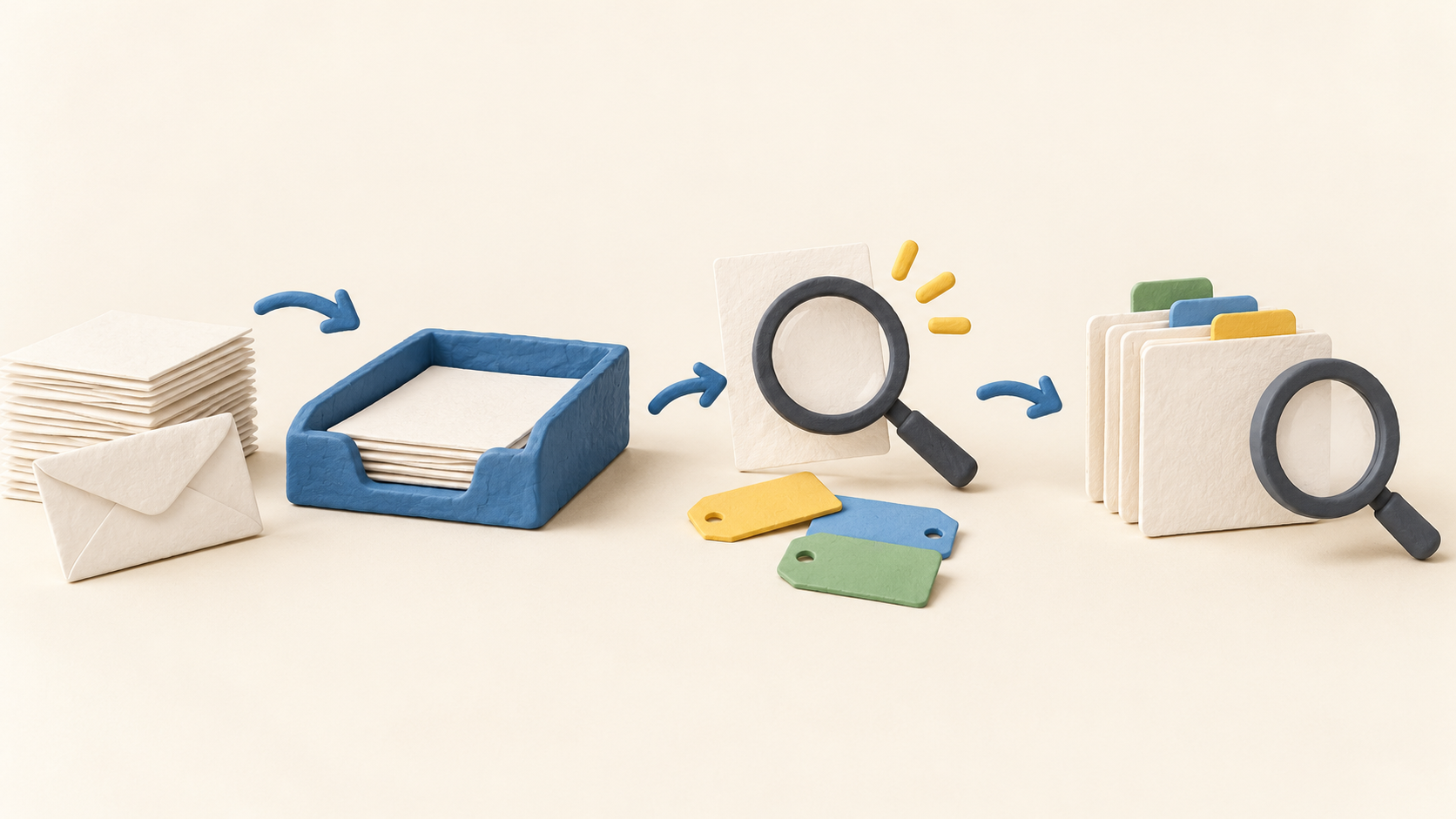
Bring documents in through the web upload page, a watched scanner folder, or a periodically polled mailbox. The watch-folder path uses Docspell's dsc tool; it is a deployment step rather than a scanner integration that happens automatically.
One item can hold several attached files. After upload, Docspell creates a PDF representation, makes image-only scans searchable through OCR and keeps the uploaded originals untouched for later download.
Docspell examines extracted text for likely correspondents, relevant people or things, document dates, due dates and tags. Treat those as suggestions: the docs explicitly recommend curating results because an automatic match can be wrong.
Use multiple tags to describe a document and an optional single folder to group it. Custom fields provide extra structured values. Tag prediction can learn from previously tagged documents, but the first small batch may not provide enough useful examples.
Find an item with full-text search or narrow the result by tags, folder, due date and custom fields. Saved query bookmarks help repeat a more involved search. A deployment may choose Solr or PostgreSQL for full-text indexing; search configuration should be tested with representative scans.
A collective can have multiple users. Folder membership changes which items appear in normal searches, yet it is not a hard security boundary: another member who knows an item ID can see the item and change metadata. Do not use folder membership alone to segregate confidential documents between users.
Docspell organizes existing documents; its current documentation says documents cannot be modified and there is no version history. It also lists no fine-grained permission management. A team needing formal revision or approval controls should test these boundaries before migrating records.
Understand the offer
Pricing and getting started
Docspell is free software under AGPLv3. The reviewed documentation describes running it yourself, with Docker images available and PostgreSQL recommended for a real setup. Hosting, administrator time and backup storage are therefore buyer costs to estimate for the chosen deployment. No fixed official hosted plan price was established in this review.
Documents are stored in the database by default, with configurable S3 or filesystem storage alternatives. The project recommends periodic database backups and keeping the deployed binaries or images. Test a restore for the actual storage choice rather than assuming the database backup covers every configuration.
For a possible exit, the CLI export can retrieve original files with item metadata. Compare a small export with the intended destination, including attachments and fields, before treating it as a complete migration plan.
Look a little closer
Before you choose
Pilot a few real document types: a searchable PDF, an image-only scan and a mailbox import. Review OCR text and proposed correspondents, dates and tags, then try the search terms people would use to retrieve each item.
Before giving multiple people access, put a sample item in a folder and verify what a second collective member can find by search and by known item ID. The documented folder behavior is not a strong access control, so sensitive collections may need a different account or product design.
Decide whether records require revision history or document changes. Docspell lacks those functions in its documented feature set. Also test a database backup, restore and CLI export before committing an archive to the system.
8 distinct sources behind this profile. Research observed Oct 18, 2026. Features and offers can change.
View sources and research →